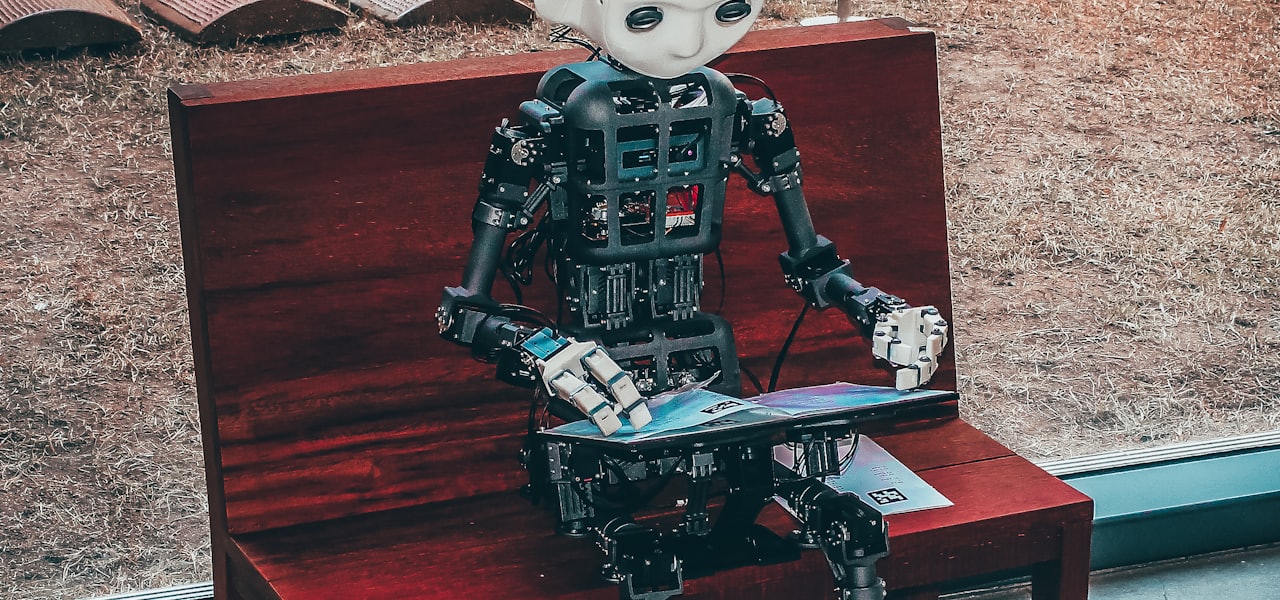
Semi-automation is a process or procedure that is performed by the combined activities of man and machine with both human and machine steps typically orchestrated by a centralized computer controller. Within manufacturing, production processes may be fully manual, semi-automated, or fully automated. In this case, semi-automation may vary in its degree of manual and automated steps. Semi-automated manufacturing processes are typically orchestrated by a computer controller which sends messages to the worker at the time in which he/she should perform a step. The controller typically waits for feedback that the human performed step has been completed via either a human-machine interface or via electronic sensors distributed within the process. Controllers within semi-automated processes may either directly control machinery or send signals to machinery distributed within the process. Centralized computer controllers within semi-automated processes orchestrate processes by instructing the worker, providing electronic communication and control to process equipment, tools, or machines, as well as perform data management to record and ensure that the process meets established process criteria. Many manufacturers choose not to fully automate a process, and instead implement semi-automation due to the complexity of the task, or the number of products produced is too low to justify the investment in full automation. Other processes may not be fully automated because it may reduce the flexibility to easily adapt the processes to reflect production needs.
IT8
IT8 is a set of American National Standards Institute (ANSI) standards for color communications and control specifications. Formerly governed by the IT8 Committee, IT8 activities were merged with those of the Committee for Graphics Arts Technologies Standards (CGATS Archived November 9, 2018, at the Wayback Machine) in 1994. == Standards list == The following is a list of the IT8 standards, according to the NPES Standards Blue Book Archived July 19, 2011, at the Wayback Machine: === IT8.6 - 2002 - Graphic technology - Prepress digital data exchange - Diecutting data (DDES3) === This standard establishes a data exchange format to enable transfer of numerical control information between diecutting systems and electronic prepress systems. The information will typically consist of numerical control information used in the manufacture of dies. 37 pp. === IT8.7/1 - 1993 (R2003) - Graphic technology - Color transmission target for input scanner calibration === This standard defines an input test target that will allow any color input scanner to be calibrated with any film dye set used to create the target. It is intended to address the color transparency products that are generally used for input to the preparatory process for printing and publishing. This standard defines the layout and colorimetric values of a target that can be manufactured on any positive color transparency film and that is intended for use in the calibration of a photographic film/scanner combination. 32 pp. === IT8.7/2 - 1993 (R2003) Graphic technology - Color reflection target for input scanner calibration === This standard defines an input test target that will allow any color input scanner to be calibrated with any film dye set used to create the target. It is intended to address the color photographic paper products that are generally used for input to the preparatory process for printing and publishing. It defines the layout and colorimetric values of the target that can be manufactured on any color photographic paper and is intended for use in the calibration of a photographic paper/scanner combination. 29 pp. === IT8.7/3 - 1993 (R2003) Graphic technology - Input data for characterization of 4-color process printing === The purpose of this standard is to specify an input data file, a measurement procedure and an output data format to characterize any four-color printing process. The output data (characterization) file should be transferred with any four-color (cyan, magenta, yellow and black) halftone image files to enable a color transformation to be undertaken when required. 29 pp. == Targets == Calibrating all devices involved in the process chain (original, scanner/digital camera, monitor/printer) is required for an authentic color reproduction, because their actual color spaces differ device-specifically from the reference color spaces. An IT8 calibration is done with what are called IT8 targets, which are defined by the IT8 standards. Example Special targets, implementing the IT8.7/1 (transparent target) or IT8.7/2 (reflective target) standards, are needed for calibrating scanners. These targets consists of 24 grey fields and 264 color fields in 22 columns: Column 01 to 12: HCL color model, which differ in Hue, Chroma, and Lightness Column 13 to 16: CMYK-Colors Cyan, Magenta, Yellow, and Key (black) in different steps of brightness Column 17 to 19: RGB-Colors Red, Green, and Blue in different steps of brightness Column 20 to 22: undefined, producers' choice After scanning such a target, an ICC profile gets calculated on the basis of reference values. This profile is used for all subsequent scans and assures color fidelity.
Kaiming He
Kaiming He (Chinese: 何恺明; pinyin: Hé Kǎimíng) is a Chinese computer scientist who primarily researches computer vision and deep learning. He is an associate professor at Massachusetts Institute of Technology and works part-time as a Distinguished Scientist at Google DeepMind. He is known as one of the creators of the residual neural network (ResNet) architecture. == Early life and education == He attended the public Guangzhou Zhixin High School in Guangzhou, Guangdong, China. He scored first place for the total scores in the 2003 Guangdong provincial undergraduate admissions exam. He went to Tsinghua University for undergraduate education and received a Bachelor of Science degree in 2007. In 2007 to 2011, he pursued doctoral studies in information engineering at the Chinese University of Hong Kong at its Multimedia Laboratory, receiving a PhD degree in 2011. His doctoral dissertation was titled Single image haze removal using dark channel prior (2011), and his doctoral adviser was Tang Xiao'ou. == Career == He worked at Microsoft Research Asia from 2011 to 2016 and at Facebook Artificial Intelligence Research from 2016 to 2024. In 2024, he became an associate professor at the Department of Electrical Engineering and Computer Science of the Massachusetts Institute of Technology. His 2016 paper Deep Residual Learning for Image Recognition is the most cited research paper in 5 years according to Google Scholar's reports in 2020 and 2021. == Awards and recognitions == He won ICCV's best paper award (Marr Prize) in 2017 and CVPR's best paper award in 2009 and 2016. He was awarded the 2023 Future Science Prize along with 3 collaborators for "fundamental contribution to artificial intelligence by introducing deep residual learning".
Collostructional analysis
Collostructional analysis is a family of methods developed by (in alphabetical order) Stefan Th. Gries (University of California, Santa Barbara) and Anatol Stefanowitsch (Free University of Berlin). Collostructional analysis aims at measuring the degree of attraction or repulsion that words exhibit to constructions, where the notion of construction has so far been that of Goldberg's construction grammar. == Collostructional methods == Collostructional analysis so far comprises three different methods: collexeme analysis, to measure the degree of attraction/repulsion of a lemma to a slot in one particular construction; distinctive collexeme analysis, to measure the preference of a lemma to one particular construction over another, functionally similar construction; multiple distinctive collexeme analysis extends this approach to more than two alternative constructions; covarying collexeme analysis, to measure the degree of attraction of lemmas in one slot of a construction to lemmas in another slot of the same construction. == Input frequencies == Collostructional analysis requires frequencies of words and constructions and is similar to a wide variety of collocation statistics. It differs from raw frequency counts by providing not only observed co-occurrence frequencies of words and constructions, but also (i) a comparison of the observed frequency to the one expected by chance; thus, collostructional analysis can distinguish attraction and repulsion of words and constructions; (ii) a measure of the strength of the attraction or repulsion; this is usually the log-transformed p-value of a Fisher-Yates exact test. == Versus other collocation statistics == Collostructional analysis differs from most collocation statistics such that (i) it measures not the association of words to words, but of words to syntactic patterns or constructions; thus, it takes syntactic structure more seriously than most collocation-based analyses; (ii) it has so far only used the most precise statistics, namely the Fisher-Yates exact test based on the hypergeometric distribution; thus, unlike t-scores, z-scores, chi-square tests etc., the analysis is not based on, and does not violate, any distributional assumptions.
Steve Omohundro
Stephen Malvern Omohundro (born 1959) is an American computer scientist whose areas of research include Hamiltonian physics, dynamical systems, programming languages, machine learning, machine vision, and the social implications of artificial intelligence. His current work uses rational economics to develop safe and beneficial intelligent technologies for better collaborative modeling, understanding, innovation, and decision making. == Education == Omohundro has degrees in physics and mathematics from Stanford University (Phi Beta Kappa) and a Ph.D. in physics from the University of California, Berkeley. == Learning algorithms == Omohundro started the "Vision and Learning Group" at the University of Illinois, which produced 4 Masters and 2 Ph.D. theses. His work in learning algorithms included a number of efficient geometric algorithms, the manifold learning task and various algorithms for accomplishing this task, other related visual learning and modelling tasks, the best-first model merging approach to machine learning (including the learning of Hidden Markov Models and Stochastic Context-free Grammars), and the Family Discovery Learning Algorithm, which discovers the dimension and structure of a parameterized family of stochastic models. == Self-improving artificial intelligence and AI safety == Omohundro started Self-Aware Systems in Palo Alto, California to research the technology and social implications of self-improving artificial intelligence. He is an advisor to the Machine Intelligence Research Institute on artificial intelligence. He argues that rational systems exhibit problematic natural "drives" that will need to be countered in order to build intelligent systems safely. His papers, talks, and videos on AI safety have generated extensive interest. He has given many talks on self-improving artificial intelligence, cooperative technology, AI safety, and connections with biological intelligence. == Programming languages == At Thinking Machines Corporation, Cliff Lasser and Steve Omohundro developed Star Lisp, the first programming language for the Connection Machine. Omohundro joined the International Computer Science Institute (ICSI) in Berkeley, California, where he led the development of the open source programming language Sather. Sather is featured in O'Reilly's History of Programming Languages poster. == Physics and dynamical systems theory == Omohundro's book Geometric Perturbation Theory in Physics describes natural Hamiltonian symplectic structures for a wide range of physical models that arise from perturbation theory analyses. He showed that there exist smooth partial differential equations which stably perform universal computation by simulating arbitrary cellular automata. The asymptotic behavior of these PDEs is therefore logically undecidable. With John David Crawford he showed that the orbits of three-dimensional period doubling systems can form an infinite number of topologically distinct torus knots and described the structure of their stable and unstable manifolds. == Mathematica and Apple tablet contest == From 1986 to 1988, he was an Assistant Professor of Computer science at the University of Illinois at Urbana-Champaign and cofounded the Center for Complex Systems Research with Stephen Wolfram and Norman Packard. While at the University of Illinois, he worked with Stephen Wolfram and five others to create the symbolic mathematics program Mathematica. He and Wolfram led a team of students that won an Apple Computer contest to design "The Computer of the Year 2000." Their design entry "Tablet" was a touchscreen tablet with GPS and other features that finally appeared when the Apple iPad was introduced 22 years later. == Other contributions == Subutai Ahmad and Steve Omohundro developed biologically realistic neural models of selective attention. As a research scientist at the NEC Research Institute, Omohundro worked on machine learning and computer vision, and was a co-inventor of U.S. Patent 5,696,964, "Multimedia Database Retrieval System Which Maintains a Posterior Probability Distribution that Each Item in the Database is a Target of a Search." === Pirate puzzle === Omohundro developed an extension to the game theoretic pirate puzzle featured in Scientific American. == Outreach == Omohundro has sat on the Machine Intelligence Research Institute board of advisors. He has written extensively on artificial intelligence, and has warned that "an autonomous weapons arms race is already taking place" because "military and economic pressures are driving the rapid development of autonomous systems".
ROCm
ROCm is an Advanced Micro Devices (AMD) software stack for graphics processing unit (GPU) programming. ROCm spans several domains, including general-purpose computing on graphics processing units (GPGPU), high performance computing (HPC), and heterogeneous computing. It offers several programming models: HIP (GPU-kernel-based programming), OpenMP (directive-based programming), and OpenCL. ROCm is free, libre and open-source software (except the GPU firmware blobs), and it is distributed under various licenses. The name initially stood for Radeon Open Compute platform; however, due to Open Compute being a registered trademark, the name no longer functions as an acronym. == Background == The first GPGPU software stack from ATI/AMD was Close to Metal, which became Stream. ROCm was launched around 2016 with the Boltzmann Initiative. ROCm stack builds upon previous AMD GPU stacks; some tools trace back to GPUOpen and others to the Heterogeneous System Architecture (HSA). === Heterogeneous System Architecture Intermediate Language === HSAIL was aimed at producing a middle-level, hardware-agnostic intermediate representation that could be JIT-compiled to the eventual hardware (GPU, FPGA...) using the appropriate finalizer. This approach was dropped for ROCm: now it builds only GPU code, using LLVM, and its AMDGPU backend that was upstreamed, although there is still research on such enhanced modularity with LLVM MLIR. == Programming abilities == ROCm as a stack ranges from the kernel driver to the end-user applications. AMD has introductory videos about AMD GCN hardware, and ROCm programming via its learning portal. One of the best technical introductions about the stack and ROCm/HIP programming, remains, to date, to be found on Reddit. == Hardware support == ROCm is primarily targeted at discrete professional GPUs, but consumer GPUs and APUs of the same architecture as a supported professional GPU are known to work with ROCm. For example, all professional GPUs of the RDNA 2 architecture are officially supported by ROCm 5.x; users report that Consumer RDNA2 units such as the Radeon 6800M APU and the Radeon 6700XT GPU also work. === Professional-grade GPUs === === Consumer-grade GPUs === == Software ecosystem == === Machine learning === Various deep learning frameworks have a ROCm backend: PyTorch TensorFlow ONNX MXNet CuPy MIOpen Caffe Iree (which uses LLVM Multi-Level Intermediate Representation (MLIR)) llama.cpp === Supercomputing === ROCm is gaining significant traction in the top 500. ROCm is used with the Exascale supercomputers El Capitan and Frontier. Some related software is to be found at AMD Infinity hub. === Other acceleration & graphics interoperation === As of version 3.0, Blender can now use HIP compute kernels for its renderer cycles. === Other languages === ==== Julia ==== Julia has the AMDGPU.jl package, which integrates with LLVM and selects components of the ROCm stack. Instead of compiling code through HIP, AMDGPU.jl uses Julia's compiler to generate LLVM IR directly, which is later consumed by LLVM to generate native device code. AMDGPU.jl uses ROCr's HSA implementation to upload native code onto the device and execute it, similar to how HIP loads its own generated device code. AMDGPU.jl also supports integration with ROCm's rocBLAS (for BLAS), rocRAND (for random number generation), and rocFFT (for FFTs). Future integration with rocALUTION, rocSOLVER, MIOpen, and certain other ROCm libraries is planned. === Software distribution === ==== Official ==== Installation instructions are provided for Linux and Windows in the official AMD ROCm documentation. ROCm software is currently spread across several public GitHub repositories. Within the main public meta-repository, there is an XML manifest for each official release: using git-repo, a version control tool built on top of Git, is the recommended way to synchronize with the stack locally. AMD starts distributing containerized applications for ROCm, notably scientific research applications gathered under AMD Infinity Hub. AMD distributes itself packages tailored to various Linux distributions. ==== Third-party ==== There is a growing third-party ecosystem packaging ROCm. Linux distributions are officially packaging (natively) ROCm, with various degrees of advancement: Arch Linux, Gentoo, Debian, Fedora , GNU Guix, and NixOS. There are Spack packages. == Components == There is one kernel-space component, ROCk, and the rest - there is roughly a hundred components in the stack - is made of user-space modules. The unofficial typographic policy is to use: uppercase ROC lowercase following for low-level libraries, i.e. ROCt, and the contrary for user-facing libraries, i.e. rocBLAS. AMD is active developing with the LLVM community, but upstreaming is not instantaneous, and as of January 2022, is still lagging. AMD still officially packages various LLVM forks for parts that are not yet upstreamed – compiler optimizations destined to remain proprietary, debug support, OpenMP offloading, etc. === Low-level === ==== ROCk – Kernel driver ==== ==== ROCm – Device libraries ==== Support libraries implemented as LLVM bitcode. These provide various utilities and functions for math operations, atomics, queries for launch parameters, on-device kernel launch, etc. ==== ROCt – Thunk ==== The thunk is responsible for all the thinking and queuing that goes into the stack. ==== ROCr – Runtime ==== The ROC runtime is a set of APIs/libraries that allows the launch of compute kernels by host applications. It is AMD's implementation of the HSA runtime API. It is different from the ROC Common Language Runtime. ==== ROCm – CompilerSupport ==== ROCm code object manager is in charge of interacting with LLVM intermediate representation. === Mid-level === ==== ROCclr Common Language Runtime ==== The common language runtime is an indirection layer adapting calls to ROCr on Linux and PAL on windows. It used to be able to route between different compilers, like the HSAIL-compiler. It is now being absorbed by the upper indirection layers (HIP and OpenCL). ==== OpenCL ==== ROCm ships its installable client driver (ICD) loader and an OpenCL implementation bundled together. As of January 2022, ROCm 4.5.2 ships OpenCL 2.2, and is lagging behind competition. ==== HIP – Heterogeneous Interface for Portability ==== The AMD implementation for its GPUs is called HIPAMD. There is also a CPU implementation mostly for demonstration purposes. ==== HIPCC ==== HIP builds a `HIPCC` compiler that either wraps Clang and compiles with LLVM open AMDGPU backend, or redirects to the NVIDIA compiler. ==== HIPIFY ==== HIPIFY is a source-to-source compiling tool. It translates CUDA to HIP and reverse, either using a Clang-based tool, or a sed-like Perl script. ==== GPUFORT ==== Like HIPIFY, GPUFORT is a tool compiling source code into other third-generation-language sources, allowing users to migrate from CUDA Fortran to HIP Fortran. It is also in the repertoire of research projects, even more so. === High-level === ROCm high-level libraries are usually consumed directly by application software, such as machine learning frameworks. Most of the following libraries are in the General Matrix Multiply (GEMM) category, which GPU architecture excels at. The majority of these user-facing libraries comes in dual-form: hip for the indirection layer that can route to Nvidia hardware, and roc for the AMD implementation. ==== rocBLAS / hipBLAS ==== rocBLAS and hipBLAS are central in high-level libraries, it is the AMD implementation for Basic Linear Algebra Subprograms. It uses the library Tensile privately. ==== rocSOLVER / hipSOLVER ==== This pair of libraries constitutes the LAPACK implementation for ROCm and is strongly coupled to rocBLAS. === Utilities === ROCm developer tools: Debug, tracer, profiler, System Management Interface, Validation suite, Cluster management. GPUOpen tools: GPU analyzer, memory visualizer... External tools: radeontop (TUI overview) == Comparison with competitors == ROCm competes with other GPU computing stacks: Nvidia CUDA and Intel OneAPI. === Nvidia CUDA === Nvidia's CUDA is closed-source, whereas AMD ROCm is open source. There is open-source software built on top of the closed-source CUDA, for instance RAPIDS. CUDA is able to run on consumer GPUs, whereas ROCm support is mostly offered for professional hardware such as AMD Instinct and AMD Radeon Pro. Nvidia provides a C/C++-centered frontend and its Parallel Thread Execution (PTX) LLVM GPU backend as the Nvidia CUDA Compiler (NVCC). === Intel OneAPI === All the oneAPI corresponding libraries are published on its GitHub Page. ==== Unified Acceleration Foundation (UXL) ==== Unified Acceleration Foundation (UXL) is a new technology consortium that are working on the continuation of the OneAPI initiative, with the goal to create a new open standard accelerator software ecosystem, related open standards and specification projects through Working Groups and Specia
Is an AI Voice Assistant Worth It in 2026?
Trying to pick the best AI voice assistant? An AI voice assistant is software that uses machine learning to help you get more done — it scales effortlessly from a single task to thousands. The best picks balance beginner-friendly simplicity with the depth power users need, and they ship updates often. Whether you are a beginner or a pro, the right AI voice assistant slots into your workflow and pays for itself fast. Read on for hands-on impressions, pricing tiers, and the standout features that matter.